Michael Guillén, PhD—former Harvard physics instructor and fourteen-year ABC News science editor—recently argued for cosmic design in a Fox News opinion essay.
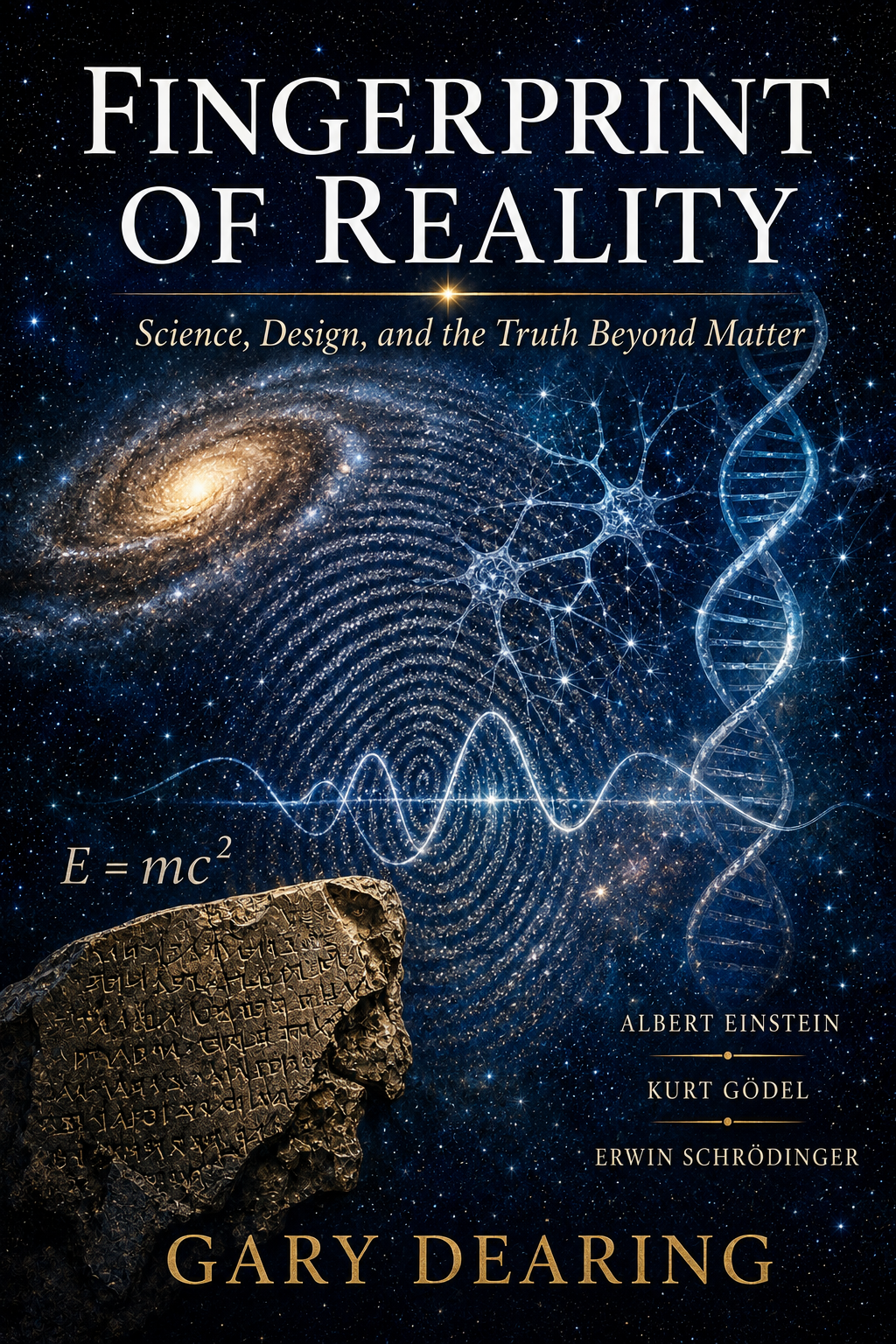
For readers of Fingerprint of Reality: Science, Design, and the Truth Beyond Matter, that is familiar ground. Accident or intention? Is the universe merely something that happened, or does its character give us reason to consider purpose?
The appearance of that question in a national publication is significant. It places before a wider audience an investigation that deserves more than a passing glance. But neither a prominent platform nor an accomplished author settles the matter. The evidence and the reasoning must carry the argument.
That is precisely where Fingerprint of Reality begins.
From a Question to an Investigation
Fine-tuning directs our attention to the conditions that make life possible. The deeper philosophical question concerns what those conditions mean. Are they brute facts requiring no further explanation? Do they follow necessarily from some deeper physical theory? Might a larger collection of universes explain why we inhabit a life-permitting one? Or do they point toward intention?
Those possibilities deserve examination, not slogans. An unexplained feature of nature does not automatically prove God. Equally, describing a possible natural explanation does not establish that the explanation is true.
We must also distinguish between explaining how something operates and explaining why such a system exists at all. A description of a mechanism can be extraordinarily successful while leaving questions about its origin and underlying conditions unresolved.
Fingerprint asks readers to keep those questions open long enough to investigate them.
Then it widens the inquiry.
One Ridge, or a Fingerprint?
Suppose cosmic fine-tuning were the only feature of reality that invited questions about purpose. It would still warrant attention. But the central proposal of Fingerprint is that we should not examine it in isolation.
Consider mathematics. Why is the physical world intelligible through mathematical relationships? Why can human reasoning grasp those relationships well enough to describe events far beyond our immediate experience?
Consider biological information. Fingerprint explores DNA, its functional organization, and the systems involved in preserving and repairing it. The relevant question is not simply whether living things are complicated. It is what adequately explains the organization that makes their functions possible.
Consider consciousness and moral experience. We do not merely observe the universe. We understand, deliberate, judge, love, and ask what we ought to do. Are those experiences fully explained by an account of matter and its behavior, or do they raise further questions about the nature of reality?
These are different subjects with different bodies of evidence. They must not be blurred together, and uncertainty in one cannot be hidden behind confidence in another. Yet neither should they be placed in separate compartments and forbidden to inform a larger judgment.
That is the book’s cumulative approach: examine each line carefully, then ask which understanding of reality best accounts for the whole.
One ridge does not identify a fingerprint. The relationship among the ridges is what makes the pattern meaningful.
What the Broader Case Requires
A cumulative argument is not strengthened merely by becoming longer. Ten weak claims do not become compelling because they appear together. Evidence must be sound, alternative explanations treated fairly, and overlapping arguments recognized rather than counted twice.
That discipline matters especially when an investigation reaches a conclusion we hope is true.
The Christian reader should not fear that standard. If we believe reality proceeds from God, honest inquiry is not an enemy to be managed. We should welcome the distinction between what the evidence establishes, what it suggests, and what remains uncertain.
Fingerprint of Reality invites that kind of examination. Its thesis is that intention deserves consideration not as a substitute for scientific investigation, but as an explanation to be assessed in light of the larger picture.
Beyond an Impersonal Designer
Even a persuasive case for cosmic intention would not, by itself, establish Christianity. The distance between a life-permitting universe and the Gospel cannot be crossed by assertion.
Questions about God’s character, human moral responsibility, our brokenness, and the identity of Jesus Christ require their own examination.
Fingerprint deliberately continues toward those questions. Its Christian destination is explicit, but the journey matters. The book moves from the possibility of intention toward the personal and historical claims that give Christian faith its distinct meaning.
For the reader, the investigation eventually becomes more than abstract. If reality has a purpose, what does that mean for the people living within it? If moral obligation is real, what does our failure to meet it mean? And if God has made Himself known, how should we respond?
Fine-tuning may open the door. It does not finish the conversation.